


With Extreme Prejudice - Investigation Into Police Vigilantism In Manchester
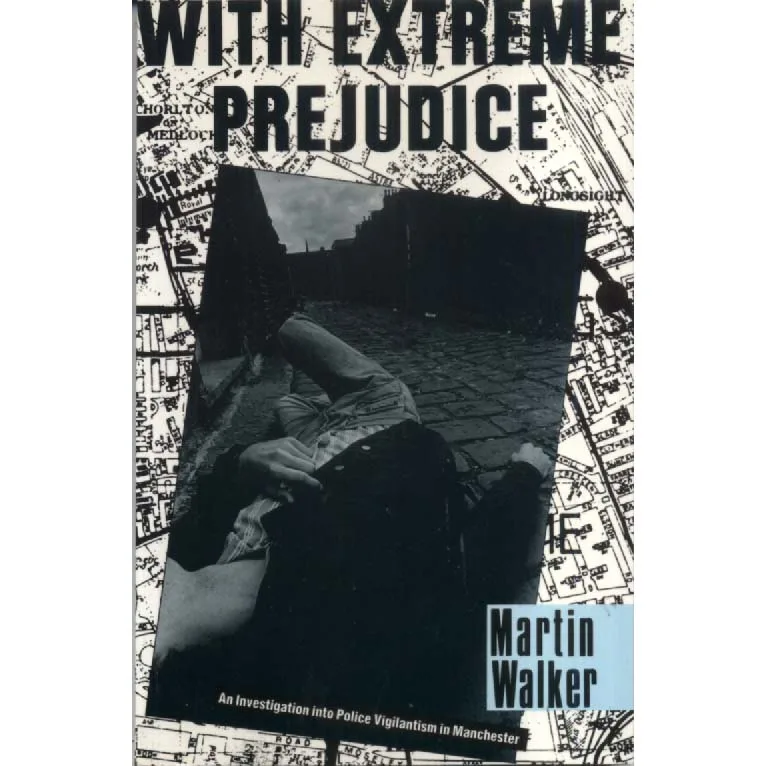
Publisher: Canary Press
Format: Paperback
ISBN: 0950996785
On 1 March 1985, Home Secretary Leon Brittan visited Manchester University Students’ Union to deliver a speech. Outside, students demonstrated; police intervened; and the resulting violence was photographed, filmed and witnessed by numerous people. What might have remained a disputed episode of public-order policing subsequently developed, according to Martin Walker’s investigation, into something much more disturbing.
With Extreme Prejudice examines allegations that police officers targeted students who had witnessed the confrontation or intended to make formal complaints. Walker describes threats, break-ins, surveillance, harassment and covert physical attacks upon a male and female student. The apparent purpose was not conventional law enforcement but the discouragement of inconvenient testimony—a method of complaint resolution unlikely to appear in the official customer-service procedure.
Walker was invited by Manchester City Council to investigate the events and conducted part of his research with Guardian journalist David Pallister. He reconstructs the original disturbance and follows the experiences of those who claimed they were pursued afterwards. The book asks what happens when officers cease merely defending one another through institutional loyalty and begin operating outside lawful procedures against the citizens attempting to hold them accountable.
The word “vigilantism” is important here. Walker’s argument is not simply that individual officers used excessive force during a confused demonstration, but that some subsequently acted as an unofficial group to protect themselves and intimidate witnesses. If true, the machinery established to investigate misconduct had been reversed: the complainants became the subjects of investigation, while those accused acquired the initiative.
Published in the aftermath of the miners’ strike and amid fierce arguments about public-order policing, the book places the Manchester incidents within a broader political landscape. During the 1980s, British policing became more militarised, politically contentious and confident in its ability to manage protest. Official language spoke of restoring order; Walker was interested in who defined order, whose behaviour threatened it and why order so frequently required demonstrators to stop keeping records.
This is campaigning reportage rather than a detached institutional history. Walker writes from the perspective of those confronting state power and combines interviews, field investigation and political analysis. His allegations should be understood as the case he constructs from his evidence, not as neutral findings delivered by a court. Nevertheless, the detail of the account and the seriousness of the questions make it an important document of policing, protest and accountability in Thatcher-era Britain.
The manuscript was reportedly written in secret and stored in a safe overnight, which gives some indication of the atmosphere surrounding its production. Most authors worry about deadlines, unsympathetic reviews and whether the printer will reproduce photographs properly. Walker had rather more immediate concerns about who might be interested in the manuscript before publication.
Issued by the small radical Canary Press in 1986, With Extreme Prejudice belongs to the tradition of independent political investigation produced outside large commercial publishing houses. It is now an uncommon book and will interest readers of British political history, civil liberties, police accountability, student protest and Manchester’s recent past. It also provides a useful historical corrective to the reassuring belief that every official complaints system has always been delighted to receive complaints.
This copy is in Near Fine condition, showing remarkably little wear and remaining clean, sound and attractive. It has survived almost forty years far better than many of the institutional reputations examined inside.
Sold by Crappy Old Books, where investigations are confined to locating missing parcels and no witness has yet required protective custody.
Keep browsing: See more Crime books Other books by Martin Walker
